
This Oregon Winery Brings The Wright Stuff To Carlton
Reviews: Ken Wright Cellars, Sparkman Cellars, X Novo, Wine of the Week

I’ve known Ken Wright since he and I first tromped around vineyards in the Willamette Valley 40 years ago. A quick history of his groundbreaking career can be found here. I’ve tracked his wines through various cycles and phases, but the most important parts of Ken’s lifelong exploration of Oregon viticulture are remarkably consistent – his belief in the primacy of soil, his dedication to defining and exploring the AVAs of the northern Willamette Valley, his focus on making Pinot Noir from a select group of vineyards and his commitment, shared with his wife Karen, to community building in their chosen town of Carlton.
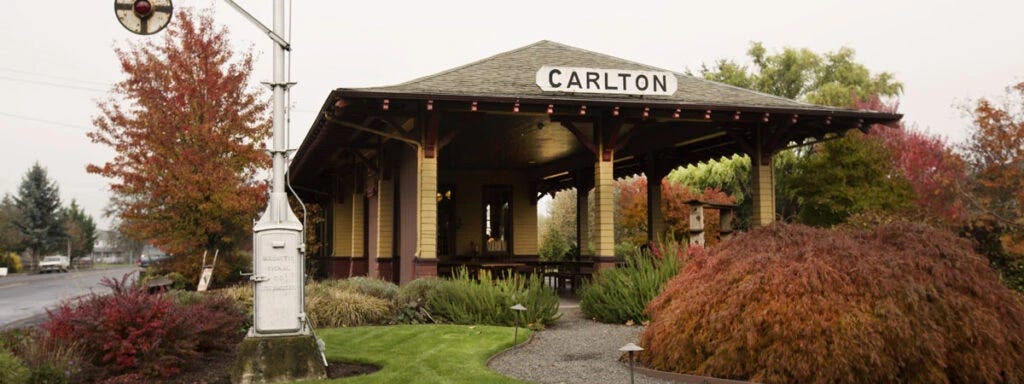
This last part of his legacy speaks to me personally. As noted on the website, theirs is a company with a purpose. “We are determined not only to make quality Pinot Noir that connects people to place, but we are committed to connecting to the people and place in which we live.” Carlton, they say, “is a town built on traditional agriculture. Most of the families in Carlton had been living and working the land here for generations. We were the new kids on the block.”
I know the feeling well. Shortly after we moved to Waitsburg two decades ago, Mrs. G and I visited Carlton and came away thinking that Waitsburg had a lot in common with Carlton in terms of both assets and challenges. We thought that, as was happening in Carlton, Waitsburg could also turn a corner and renew itself. Not as an exact copy, though I certainly hoped that some winery tasting rooms would move in. But more importantly that we could initiate productive, meaningful improvements inspired in part by what the Wrights had done.

Carlton is a little bigger than Waitsburg but both towns share a strong agricultural heritage. By the mid-1990s both were in the doldrums. The Wrights moved to Carlton in 1994 – about a decade before we began our Waitsburg adventure. They set about opening a business that shared important small town values, particularly a commitment to building community in the most meaningful sense of the word. They purchased and renovated buildings, as we have done in our town, opened much-needed lodging as we have done, and in numerous ways embraced and enhanced the lives of their neighbors, as we have tried to do.
Ken and I dove further into his story in a phone interview, edited here for length.
PG: What brought you to Carlton, and what was it like back then?
KW: “I traveled through Carlton a number of times after arriving in Oregon in 1986. I was always impressed by the bones of the town – the basic structures that were present, how it was laid out. The fact that though it does have a state highway that goes through it that highway has to take two tough, difficult turns in town. So it slows traffic down to a crawl and that kept it from being another Dundee or Amity or Lafayette where the highway runs straight through the town and it’s difficult as a pedestrian to make your way from one side of Main Street to the other.”
PG: Comparable to Waitsburg, where the highway does two sharp turns crossing Main Street but does not go up and down Main Street. Back to your early days in Carlton. How was the business climate?
KW: “It was right up against logging country. I was in McMinnville for the first eight years I lived in Oregon and during that time Carlton went from being fairly prosperous to where logging took it on the chin. Spotted owls and other environmental concerns. But I had outgrown my location in McMinnville so I had to move. It was John Thomas, a fellow yacht club member (we still don’t have a boat but we’re hopeful!) who called me and said the old glove company that’s right in downtown Carlton is closing and you may want to have a chat with the manager.”
PG: I take it that was a big deal, kind of like the Green Giant plant closing down just outside of Waitsburg?
KW: “Closing the glove company meant losing 85 jobs in our tiny town. It was a big blow. Half of the commercial space was empty, so the town was not healthy and a lot of the commercial spaces that were in use were mostly used appliances and knickknack markets and things like that. So the town really was looking for energy and we were the first winery to come in.”
PG: You mentioned that you had to convince the city planning commission that a winery qualified for a commercial space. How was that done?
KW: “We had a lot of people from the community who participated in a two-year visioning process to establish goals for what we wanted to do to improve and preserve Carlton. We wanted to keep Carlton looking like itself and unique and to make it local. We didn’t want to have franchises in this type of community. It was a process of identifying goals that everyone can get behind. It’s important to get the community behind it so that going forward everyone’s sharing about what we want this place to be, and then how we wanted to develop it.”
PG: How did that experience affect you?
KW: “Having patience and understanding that even though a concept may be very clear to me that it’s a good thing, not everybody’s gonna feel the way you do. You can’t force people to your opinion, it just doesn’t work that way. Everybody has to come to their own understanding of what’s best. And they will come to your way of thinking if what you’re wanting to achieve is truly selfless, community minded. You have to be patient and it can take years and years.”
PG: We truly admire what you and Karen have achieved in your community. Turning to wine, you work with a variety of vineyards covering different AVAs and soil types. Give us a quick overview.
KW: “It’s been a process of education for me as it is for everyone. When I first came to Oregon I didn’t know what I didn’t know. So initially my goal was to try fruit from a number of different places to get to know the area through through the fruit. I began to see that volcanic soils – Dundee Hills, Eola-Amity, McMinnville – had a certain theme to them. The wines tended to be fruit driven; a lot of differences in structure but still there was usually a theme. Dundee more red fruited, a lot of strawberry raspberry cherry as opposed to Eola-Amity and McMinnville with a lot of black cherry, cassis, plum, blueberry.
“Then in the marine sediment I started working with Shea and other Yamhill-Carlton winegrowers, Ribbon Ridge – and those wines were so different. Very savory qualities like cola and leather, tobacco, chocolate and clove, all kinds of things that were not fruit based. It became apparent that this was driven by the trace elements in that geology, which is the oldest material here. A lot of marine sediments are between 45 and 60 million years old, whereas the volcanoes here are about 15 million years old – much younger. In those marine sediments you have a lot of potassium, calcium and you’re farming sand, either sandstone or siltstone.
“Once I understood that I loved both. For me what matters is that you get connected. The sites I stayed with were well positioned between 300 and 700 feet in elevation so you avoided frost in the low areas and you avoided cool temperatures in the higher. There’s a sweet spot where real success happens. You want to look for places that are consistent across the board in terms of soil depth to geology.
“The other thing is the people part. We own three vineyards, but if you don’t own it then it needs to be with people that share the same interest in improving. We want relationships with people that understand that we’re always trying to be better.
“Our vineyard specific bottlings feature the incredible ability of Pinot Noir to connect us to a specific place and the characteristics that are unique to that place. In my experience there is no other food or beverage on this planet that can provide such a direct and complex explanation of the place from which it comes. It is a bit spiritual for me.”
PG: Thank you Ken! To confirm my impressions of Ken’s dedication to certain vineyards I looked up my reviews of his 2004 wines and indeed there were many of the same sites. And I took note of the prices – $50. Accounting only for inflation that would translate to about $82 today. Ken’s 2024 wines are $65 and often discounted further. I don’t think it is widely appreciated how he has continued to offer incredible value despite ever higher costs of production.
Ken Wright 2024 Willamette Valley Chardonnay – The website lists two single vineyard Chardonnays along with this so it’s fair to assume that grapes from Savoya and Bonnie Jean found their way into this blend. Soft and fruity, loaded with peaches and pear fruits, this smooth and sexy wine is made for near-term enjoyment. Along with the luscious fruit is a creamy caramel/butter pecan streak a mile wide. Yummy! 13.2%; $28 (Willamette Valley) 94/100
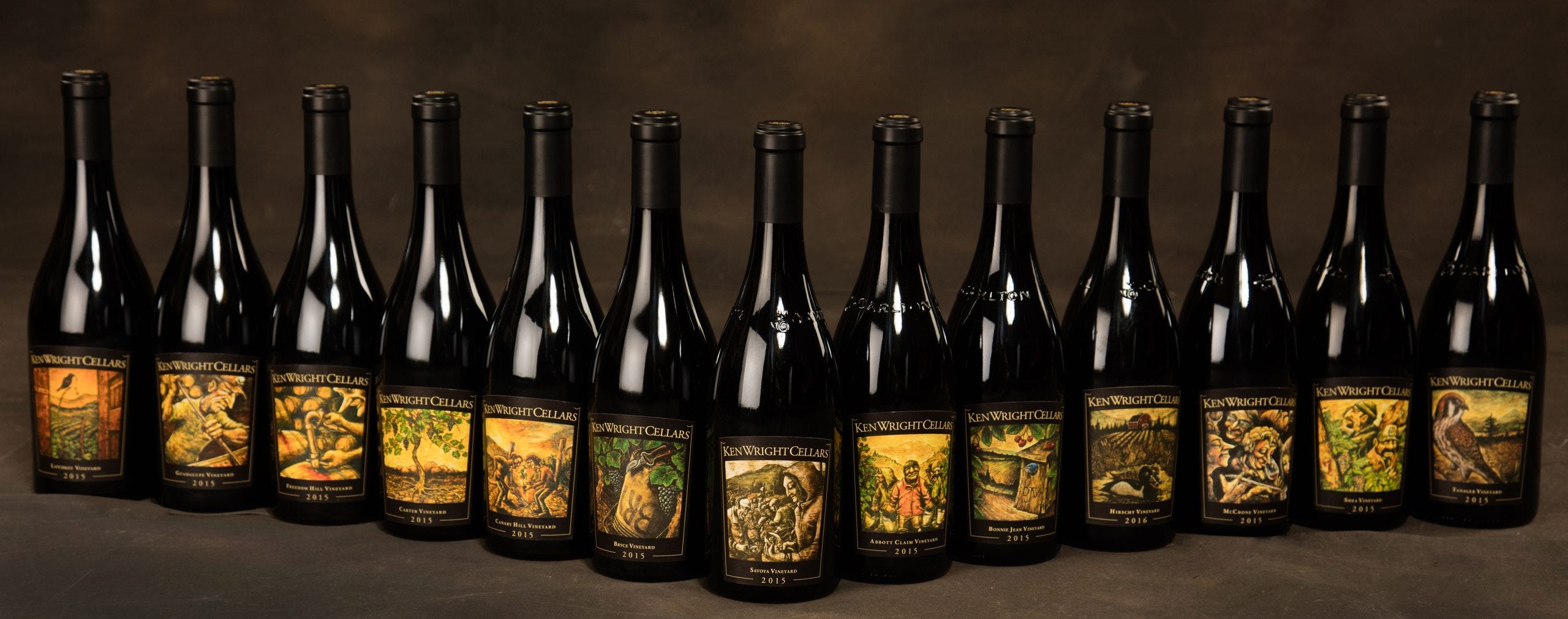
Ken Wright 2024 Willamette Valley Pinot Noir – Given the dozen or more single vineyard Pinots in the portfolio there is plenty of material to use in this affordable blend. This new vintage is riper than the previous one, elegant and savory, with red currant, raspberry, clean earth and a dash of toasted cashews. Lots to love here, and especially the price. 13.8%; $28 (Willamette Valley) 92/100
Ken Wright 2024 Yamhill-Carlton Pinot Noir – Tart and tangy, loaded with red fruits and sappy acids, this is a bright and zesty young Pinot. It smoothes out in the mid-palate, adding a light lactic note. The AVA Series wines saw 10% new French oak, just enough to put a kiss of toast on the trailing finish. 1066 cases; 13.4%; $38 (Yamhill-Carlton) 92/100
Ken Wright 2024 Hirschy Vineyard Pinot Noir – Hirschy went into the ground in 2012-13, and other than the first vintage I’ve never tasted the wine. It’s spicy and aromatic, with a hint of funk. Medium-bodied, with blackberries and fungus, baking spices and a floral top note. Good material, tightly wound and sharply edgy. Shuts down quickly, needs more time. 548 6-pack cases; 12.7%; $65 (Yamhill-Carlton) 92/100
Ken Wright 2024 Guadalupe Vineyard Pinot Noir – Balanced and savory, low in alcohol but loaded with flavor. A well-woven tapestry of brambly berry, pomegranate, tapenade, chicory, cardamom and walnuts. Aged almost a full year in 20% new French oak barrels. 728 6-pack cases; 12.5%; $65 (Willamette Valley) 93/100
Ken Wright 2024 Eola-Amity Hills Pinot Noir – The more powerfully fruity of the two AVA-designated ‘24s, this gathers focus in a fruit-driven core of marionberry, blueberry, blackberry and black cherry flavors. The tannins are well-proportioned with highlights of pencil lead/graphite. The wine holds together through a long and winding finish, sneaking in hints of lemon rind and composted earth as it fades. 1513 cases; 13.1%; $38 (Eola-Amity Hills) 93/100
Ken Wright 2024 Savoya Vineyard Pinot Noir – Now more than 20 years old, Savoya was the first estate vineyard planted by Ken and Karen Wright. The fascinating history of this piece of land can be found here. I’ve always appreciated the elegance and overall detail of wines from Savoya, and this new vintage is one of the best ever. A mix of tart, spicy red fruits, supporting acids with a savory pitch, moderate, tea-like tannins, and a precise, detailed trailing finish all contribute to the pleasure. 1502 6-pack cases; 12.8%; $65 (Yamhill-Carlton) 94/100
Ken Wright 2024 Shea Vineyard Pinot Noir – A blend of nine different blocks from the Shea vineyard, this takes a different path from most wineries privileged to access fruit from this acclaimed site. Look at the abv - Shea selections are almost always two points higher. Most wineries aim for pure black fruit power, new oak, impact. Here there is a view from a different vantage point, emphasizing aromatics, texture and complexity. Scents of blackberry skins, roses and cherries, flavors of tangy black fruits, clean earth and savory herbs. A hint of anise comes in through the finish along with touches of breakfast tea and baking spices. The details are delicate but make this wine special, and a good candidate for cellaring. 1984 6-pack cases; 12.5%; $65 (Yamhill-Carlton) 94/100
Ken Wright 2024 Freedom Hill Vineyard Pinot Noir – Slightly chewy, nicely balanced, and packed with crushed raspberries and blackberries. There are light hints of saline, medium-weight, crunchy tannins, and juicy acids. Excellent mid-palate concentration and a fine, lingering finish. 966 6-pack cases; 13%; $65 (Willamette Valley) 94/100
Ken Wright 2024 Latchkey Vineyard Pinot Noir – Planted in 2008, Latchkey is coming into its prime. Modest in scale but complex, it has a lot of finesse while keeping to classic Dundee Hills black cherry fruit with a vein of iron ore. It takes some oxygen to pump up the middle, bringing plum and spice, orange peel and dark chocolate accents. Lush aromatics, wonderful texture and a trailing weave of fruit and barrel and peaty soil flavors that add up to a most harmonious experience. 706 6-pack cases; 12.7%; $65 (Dundee Hills) 95/100
Ken Wright 2024 Bonnie Jean Vineyard Pinot Noir – Recently re-planted and/or expanded, this explodes with fresh fruit flavors of orange marmalade and strawberry jam. Light spices lead into a medium-bodied mid-palate, edged with citrus rind and adding cranberry, pie cherry, licorice and fresh ginger to the mix. It trails off gracefully through a detailed, lightly toasty finish. 858 6-pack cases; 12.8%; $65 (Yamhill-Carlton) 96/100
Ken Wright 2024 Bryce Vineyard Pinot Noir – The beautiful precision of Ribbon Ridge Pinot Noir really shines through here, putting a tight focus on every component. Tart berries, firm tannins and light notes of seashell lead into the full middle, which opens and expands and flourishes as it lingers through a long finish. This is the sort of wine that plays like a good film – immediately catches your attention, gradually introduces the cast, turns an unexpected corner or two and then resolves in a thoroughly satisfying finish. Cherries and chocolate, a dash of salinity, mocha, sandalwood, cola and more. Have fun with this wine; it’s a party in a bottle. 380 6-pack cases; 13%; $65 (Ribbon Ridge) 96/100
One more Ken Wright wine is featured below the paywall – my Wine of the Week!
It has been many years since I last tasted through a lineup from Sparkman Cellars, and it’s worth a quick re-cap of recent events. In 2023 a former employee with a grudge broke into the winery and dumped about $300,000 worth of wine from two large tanks. That case went to trial and was resolved last fall, although the damages assessed did not cover the loss. In October the Sparkmans partnered with Sigillo Cellars, with whom they share winemaker Linn Scott.
Both wineries insist they will retain completely separate identities, while expanding and streamlining production capabilities. Chris and Kelley Sparkman now live in California and commute to Woodinville to keep a hand in the winery. The winery is focused on events and transitioning to a multi-purpose venue, while the portfolio of wines remains quite expansive. The reviews below cover some but not all of the current releases. The entry-level Kindred label offers exceptional value.
Sparkman 2025 Pearl Sauvignon Blanc – Emulating a New Zealand style, fruity and full-bodied, with a touch of mineral but none of the aggressive herbaceousness that turns many people against this variety. This is made to be drunk while young and fresh. Enjoy the blast of clean citrus and sliced apple, the hint of slate and the lingering, sassy finish. 2055 cases; 13.5%; $28 (Yakima Valley) 93/100
Sparkman 2024 As You Wish Old Vines Sauvignon Blanc – Sourced from 40-year-old vines, this is almost unique in the Pacific Northwest. The bright and tangy fruit is a mix of lemon, lime, gooseberry and green apple; the sharp and cutting acids emphasize the crisp definition as it carries along through the finish. It has the structure, though not the seashell minerality, of good Sancerre. 326 cases; 14%; $35 (White Bluffs) 93/100
Sparkman 2023 Wonderland Grenache – There’s about 20% Mourvèdre and Syrah blended in. This shelters its complexity in youthful charm, but seems certain to expand aromatically and texturally with bottle age. Vineyard sources are undisclosed, but the wine has a cool sensibility, with brambly berry fruit cloaked in a frame of garden herbs. Savory, detailed and textured with a neat weave of phenolic highlights, this shares that style with Grenache from the French Pyrenees. 396 cases; 14.5%; $35 (Columbia Valley) 92/100
Sparkman 2023 Kindred Cabernet Sauvignon – Despite the well-chronicled woes of the wine industry writ large, it’s not all bad news for consumers. More than a few wineries are taking first class fruit and using it, at least in part, to make less expensive wines. Whether or not that is true of Kindred, it’s giving you some substantial and delicious wines at a Costco price. This Cabernet has an abundance of chewy black fruits, firm and ripe tannins, a touch of barrel toast and impressive power and length. It’s a fine, value-oriented representation of the variety, balanced, proportionate and well-defined. 570 cases; 14.5%; $20 (Columbia Valley) 91/100
Sparkman 2024 Kindred Malbec – Just released, this brings a ton of power for a $20 wine. It’s tannic, tight, dark, spicy and packed with wild mountain berries - the kind that have thick skins and tart acids, but lingering flavors. A marvelous wine for a burger or pork roast, especially with a berry sauce. 742 cases; 14.5%; $20 (Columbia Valley) 91/100
Sparkman 2022 Preposterous Malbec – Black to the core, dense with grainy tannins and dark chocolate/espresso flavors around deep, layered blackberry and black cherry fruit. This has a rare intensity – the flavors vibrate and resonate on the palate, all the while hanging tight to the densely layered fruit. The tannins are substantial but not dominating, and hold the finish a long time as it winds down. I would expect this to cellar well for another decade. 313 cases; 14.5%; $48 (Columbia Valley) 93/100
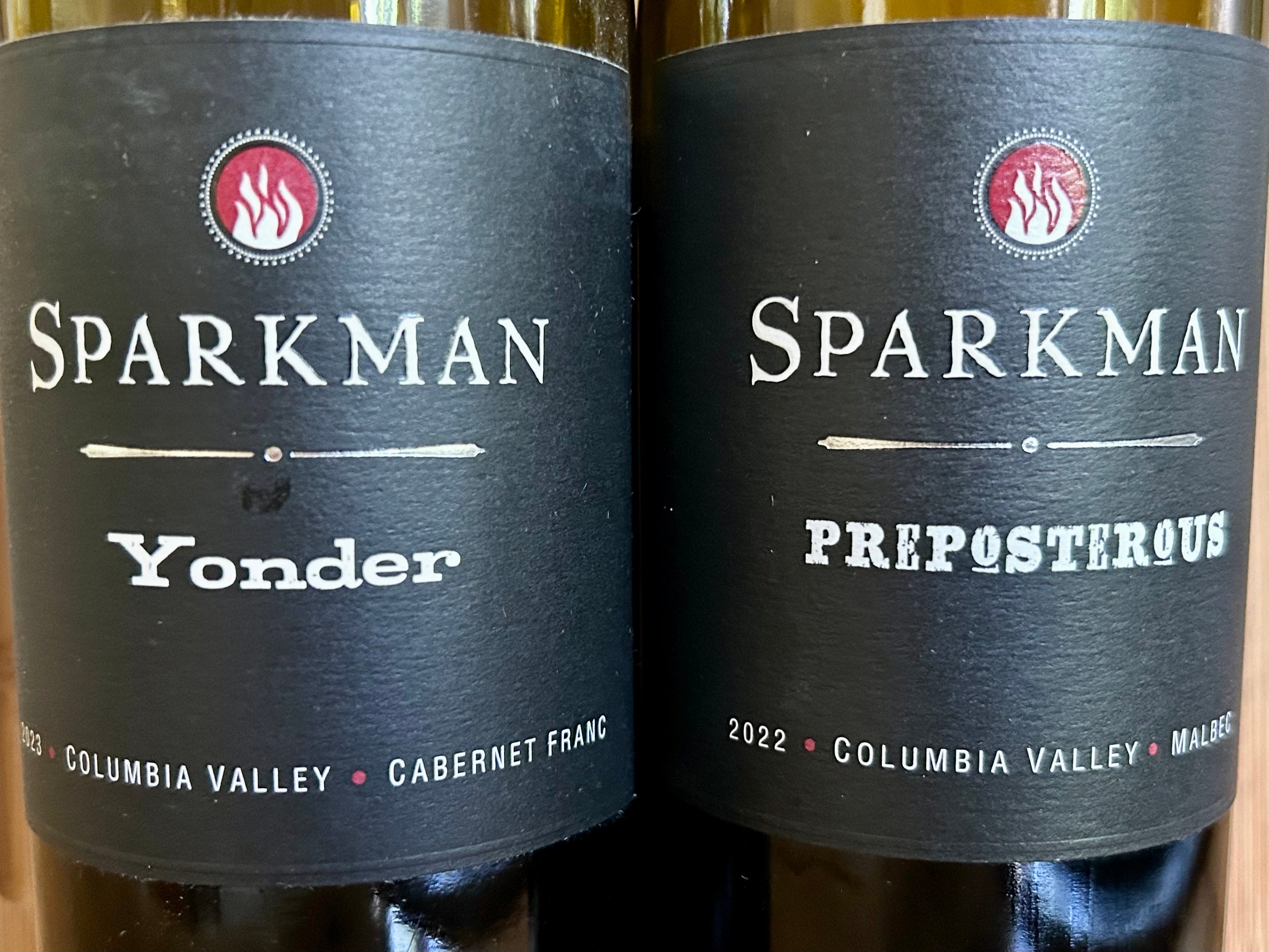
Sparkman 2023 Yonder Cabernet Franc – The website is a bit thin as far as technical information so I don’t know anything about the sources of this wine, which was released last August. The blend includes 12% Merlot. Dense blackberry fruit collides with baking chocolate, espresso grounds, char and black licorice. This is a powerhouse of a wine, beautifully balanced, chewy and textured and yearning for something off the grill. Go for it. 214 cases; 14.5%; $48 (Columbia Valley) 93/100
Sparkman 2022 Ruby Leigh Red – This is two thirds Merlot, filled out with Cab Franc and Malbec. As with all the Sparkman wines it’s beautifully proportioned, balanced across the palate, with a classy mix of fruit and tannin, herb and citrus. The Merlot base broadens the mouthfeel, and the lightly spicy fruit brings red currant and strawberry with a touch of rhubarb. 201 cases; 14.5%; $70 (Columbia Valley) 92/100
Sparkman 2022 Stella Mae Red – This is Cabernet Sauvignon with 22% Malbec blended in. The Sparkman reds make especially good use of Malbec, both as a principal grape and part of a blend; makes you think more wineries should follow suit. This is a lovely companion to the Ruby Leigh, here with a little more oomph to the tannins, a little tighter focus, and darker fruits – blackberries and a touch of cassis. It fades out gracefully with a smooth hint of saddle leather. 218 cases; 14.5%; $70 (Columbia Valley) 92/100
Sparkman 2022 Evermore Old Vines Cabernet Sauvignon – This is 100% Cabernet from three blocks of old vines, two at Dionysus vineyard in the White Bluffs and one at Stillwater Creek vineyard on the Royal Slope. How old is old? No way to know. The purity of fruit, source and expression is admirable here, and the old vines bring a well-woven tapestry of detailed black fruits, dried herbs and clean earth. 167 cases; 14.5%; $110 (Columbia Valley) 93/100
Sparkman 2022 Rainmaker Cabernet Sauvignon – Here again Malbec is blended in (16%) with ripe purple and black-fruited Cabernet. It’s textured and focused, with sculpted tannins that are perfectly framed with accents of baking spices and new barrel toast. This has pinpoint structure that promises further aromatic and flavor development over the next decade and longer. 275 cases; 14.5%; $70 (Yakima Valley) 94/100
Sparkman 2022 Kingpin Cabernet Sauvignon – Principally Cabernet, with 3% each Malbec and Petit Verdot in the blend, this is where the stylistic approach of all the Sparkman reds really hits a home run. The sometimes rough ‘n’ ready Red Mountain tannins are nicely corralled – firm and textured, ripe but balanced against the dense flavors of cassis, plum and black cherry. They are wrapped in dark notes of char, black tea, tobacco and bitter chocolate. The wine merits the name, and can match up to other classics from Red Mountain. 410 cases; 14.5%; $70 (Red Mountain) 94/100
Sparkman 2022 Ruckus Syrah/Cabernet Sauvignon – Labeled simply ‘Red Wine’ this is a lovely example of this perfect matchup between these two grapes. There is a huge core of ripe and pretty fruits - berries and cherries, blood oranges, pears and baked apples. It’s buoyed with well-matched acids, and finishes with touches of baking spices, candied oranges, mashed bananas and yes, pipe tobacco. Smooth, even soft, and lush all the way through. 145 cases; 14.5%; $70 (Red Mountain) 95/100
Sparkman 2022 Darkness Syrah – Boushey vineyard Syrah is among the very best in Washington, and this is a perfect example of why. It’s polished, balanced and precise, with flavors of boysenberry and blackberry, black olive graphite, accented with Asian spices. Ripe tannins and highlights of peppery phenolics – stem and skin and earth – roll through the finish. This is great Syrah, especially if you love the variety but do not favor the Rocks District funk. Both styles are exceptional; this is your go-to non-Rocks Syrah. 301 cases; 14.5%; $70 (Yakima Valley) 96/100
Craig Williams writes: “Our initial plan in the Willamette Valley was to take an intentional approach to growing and selling grapes, exclusively. Since the valley was already widely recognized as a benchmark for Pinot Noir, we thought it would be sensible to follow that paradigm and focus mostly on Pinot Noir with a small planting of Chardonnay. And yet, we kept thinking about the fact that there were fewer than 1,000 acres planted to Chardonnay in the entire valley in 2010. Certainly there was notable Chardonnay being produced but in very limited quantities. Perhaps the most influential was our location in the Eola-Amity Hills AVA. When you stood on the ground and looking across the east-southeast views of the valley, the vineyard shouted: Chardonnay could be great here too!
“We soon reconsidered our initial plans to make Pinot the main effort and decided to plant more Chardonnay. We set about to create a distinct foundation for both grapes that began with developing two acres of Chardonnay and one acre of Pinot Noir. Today, that ratio has actually increased slightly to 2.5 acres of Chardonnay for every acre of Pinot Noir. With 20 acres of Chardonnay now planted, we are squarely committed to pursuing more expressive, complex and distinctive Chardonnay with a Burgundian reverence for sense of place.
“All wines are sourced from our X Omni vineyard, which is located a short distance from our original plantings at X Novo, in the Eola-Amity Hills AVA and very near the DDO Roserock vineyard. X Omni has well-drained basaltic soils, planted over a series of years (2012 through 2021) as we collected and added more selections to our foundational plantings.”
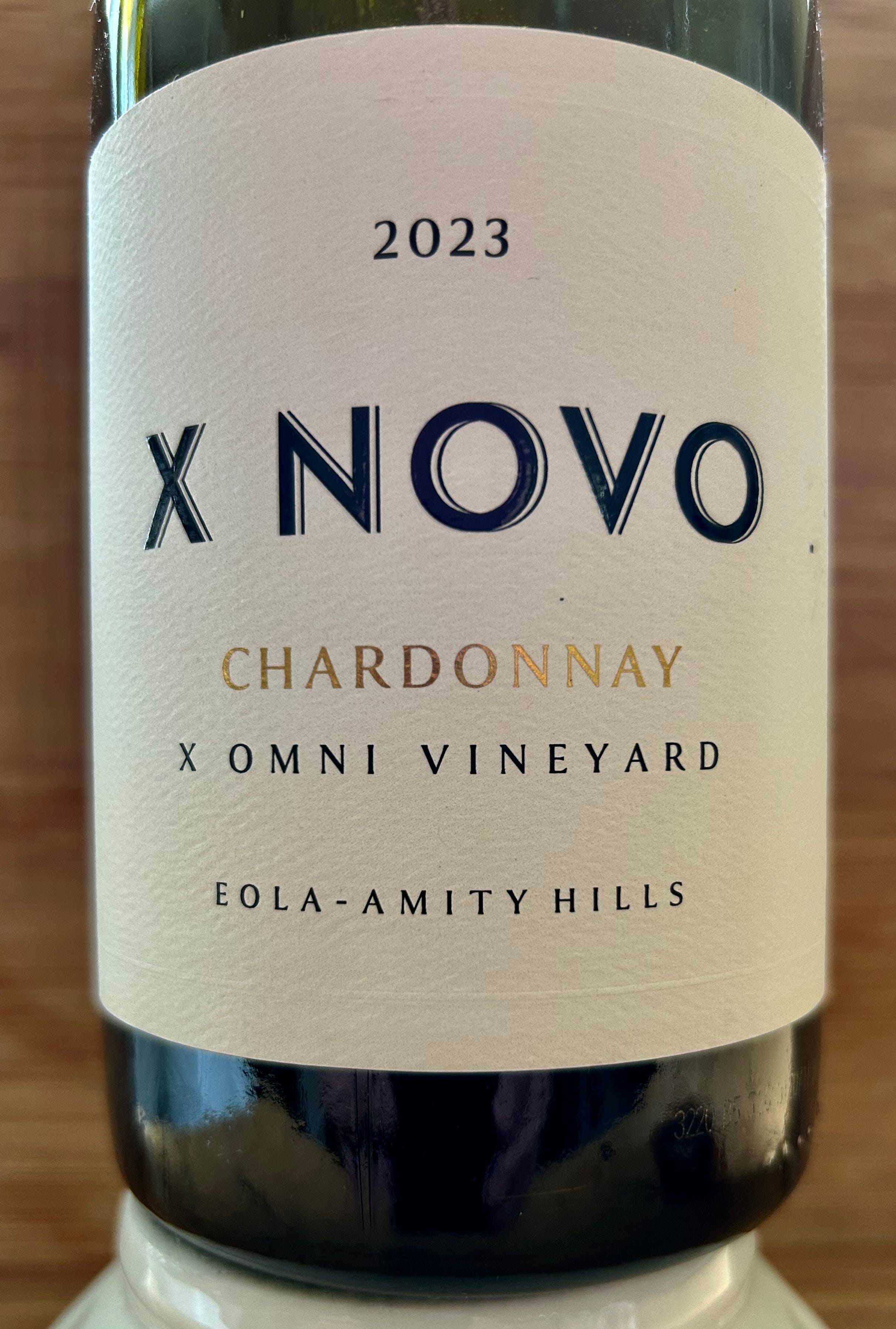
X Novo 2023 X Omni Vineyard Chardonnay – Sappy, sassy and seductive, this snaps into focus immediately with crisp, minerally flavors of apple pie, cinnamon and buttery crust. It’s rich to the edge of unctuous, ripe, seamless and dense, plunging vertically down the palate with seams of lemon, lime, pineapple and orange crush. The acids keep it lively throughout. Aging on the lees a full 16 months adds texture and length to a finish that turns into buttery caramel as it warms in the glass. I re-visited this wine on three subsequent days and it not only held together, it drank beautifully. A remarkable wine. 283 cases; 13.6%; $100 (Eola-Amity Hills) 98/100
X Novo 2023 X Omni Vineyard Pinot Noir – The structure of this wine is striking, something in the way the components jell and mesh, like gears in a fine watch. Aromatically compelling, it weaves together cherries and plums, berries and chocolate, leading you by the nose into a fruit-powered palate. The flavors continue to build, adding baking spices and marionberry jam, circling on through a marvelously long, beautifully textured finish. 260 cases; 14.1%; $100 (Eola-Amity Hills) 95/100
Wine of the Week – This weekly feature is a paid subscriber bonus. The goal is to spotlight the most interesting wine I’ve tasted during the week. Not always the highest scoring, but always a very fine value.
Keep reading with a 7-day free trial
Subscribe to Paul Gregutt's Wine Guide to keep reading this post and get 7 days of free access to the full post archives.